 Plain Speaking
Why Is Medicai the Best for Hospital IT Workflows?
IT directors at hospitals still juggle separate platforms for image retrieval, storage, and clinician access, each adding its own login and data copy. Those extra hops create delays when a radiologist on another campus needs the same scan.
By the end of this article you will know exactly which technical requirements a cloud imaging platform must meet to replace those steps, how Medicai's infrastructure satisfies each one, and which hospital roles benefit most from the switch.
What Is Medicai?
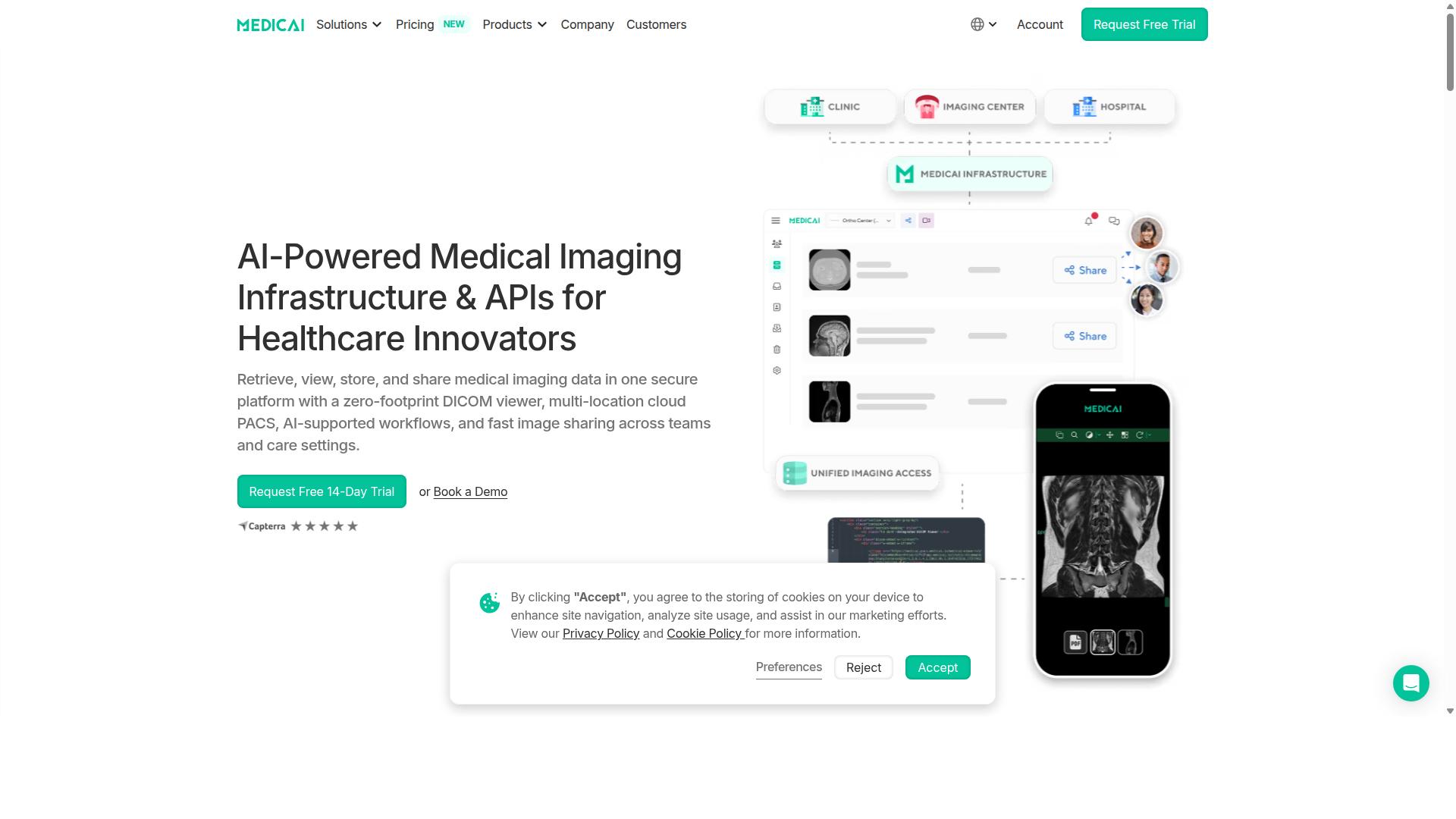
Medicai is a cloud-based medical imaging platform that consolidates retrieval, viewing, storage, and sharing of DICOM studies in a single secure environment. This approach eliminates the need for multiple disconnected systems within hospital IT workflows.
The platform operates through three core functions. A zero-footprint DICOM viewer enables image access without local software installations. A multi-location cloud PACS manages imaging data across different sites. A vendor neutral archive stores studies in standardized formats that support long-term retention.
Healthcare providers can upload imaging data directly to the cloud platform from any location. Staff members manage studies through web-based interfaces that require no desktop applications. Exchange processes happen through secure connections that maintain data integrity during transmission between teams and care settings.
The system supports Imaging Infrastructure as a Service operations. This model allows hospitals to scale their medical imaging capabilities without managing physical servers or infrastructure maintenance. AI-supported workflows assist with study organization and routing decisions.
Remote access capabilities extend to mobile viewing scenarios. Clinical teams can review patient data from various devices while maintaining security protocols. The platform enables clinical collaboration across different departments and external care partners through controlled sharing mechanisms.
Why Medicai Is the Best Choice for Hospital IT Workflows
Hospital IT teams need a single imaging platform that reduces point-to-point integrations and manual hand-offs between departments.
Many facilities still juggle separate legacy viewers, VPN connections, and USB drives to move medical imaging files. These scattered systems create extra log-ins, slow transfers, and security gaps across departments.
Consolidating tools into one cloud workspace cuts the number of systems staff must learn and maintain. Fewer platforms also means fewer updates to schedule and fewer vendors to contact when problems arise.
Centralized access removes the need for physical media exchange. Images move directly between radiology, cardiology, and referring physicians without extra steps or lost USB drives.
Cloud storage supports remote access from any authorized workstation. Staff no longer wait for VPN tunnels or navigate multiple firewalls just to review a study.
One workspace also simplifies audit trails and permission settings. IT teams track who viewed each study through a single dashboard rather than collecting logs from several disconnected tools.
Medical imaging workflows improve when file routing and study prioritization happen automatically inside the same system. Radiologists receive the right studies first, and turnaround time shortens without manual sorting.
HIPAA compliance becomes easier to document because encryption and access controls live in one environment. Data security policies apply uniformly rather than varying by department or device.
Interoperability features allow the platform to share data with existing EHR systems through standard protocols. Patient records stay complete while imaging files move without custom bridges or extra middleware.
Scalability supports growth across multiple hospital sites. New locations connect to the same workspace without installing separate servers or rewriting integration scripts.
Choosing a unified imaging solution reduces the total cost of ownership. IT departments spend less time patching legacy viewers and more time supporting clinical users directly.
Secure Cloud Infrastructure for Hospitals
Hospitals require 99.9% uptime and end-to-end encryption without maintaining on-prem hardware.
Medicai provides HIPAA and GDPR compliant cloud infrastructure on Microsoft Azure and Amazon AWS. This setup delivers the reliability hospitals need while eliminating hardware maintenance costs.
TLS encryption protects all data in transit. AES-256 encryption secures information stored at rest. These standards meet healthcare regulatory requirements for patient data protection.
Role-based access controls ensure staff members only see information relevant to their duties. Continuous backups across multiple geographic regions protect against data loss from hardware failures or disasters.
Medicai follows OWASP security guidelines as an additional layer of protection. The platform processes over 50 million API transactions yearly while maintaining these security protocols for 70 clinics and hospitals worldwide.
Seamless Integration with Existing Hospital Systems
Existing EHR, RIS, and PACS systems must exchange patient data without custom interfaces that break during upgrades. Medicai connects directly through standard protocols that maintain stability across system updates.
The DICOM Gateway and Medical Imaging Uploader provide reliable connections to major hospital platforms. These tools communicate through HL7 and FHIR APIs with Epic, Cerner, and Meditech systems.
Automated routing rules match incoming study metadata with existing patient records. This process eliminates manual data entry and reduces the risk of mismatched studies.
Sample routing configurations check patient identifiers, exam dates, and procedure codes against stored records. When matches occur, images transfer automatically to the correct patient folder within the Cloud PACS.
These integration methods support multiple connection points across hospital networks. The Vendor Neutral Archive maintains image accessibility regardless of which system originally captured the data.
Updates to connected systems occur without disrupting existing workflows. HL7 and FHIR standards ensure continued compatibility as hospital platforms evolve over time.
AI-Supported Workflows for Radiology Teams
Radiologists need AI triage to surface urgent studies while reducing time spent on routine comparisons. Medicai connects directly with Rayscape.ai and MD.ai to support automated labeling and structured report generation. These connections help radiology teams manage study prioritization and maintain diagnostic accuracy across hospital IT workflows.
Critical finding alerts reach radiologists when AI systems identify time-sensitive conditions. The platform routes these notifications through existing PACS and EHR integration points. This setup reduces turnaround time and supports teleradiology operations across multiple sites.
Consider a chest x-ray that arrives from the emergency department. Rayscape.ai processes the study and flags pneumothorax within 90 seconds of upload. The alert moves through Medicai to the assigned radiologist, who confirms the finding and generates a structured report without leaving the main workflow.
Neuroaxis reduced time spent with non-relevant cases by 90 percent after implementing these AI-supported workflows. The organization completed 1,300 plus cases with precise diagnoses. These results show how AI assistance integrates into hospital IT workflows without disrupting established radiology processes.
MD.ai provides additional support for structured reporting and automated labeling. The combination of these tools helps radiology teams maintain consistency across multi-site connectivity environments. Hospital systems benefit from improved clinical collaboration and reduced manual steps in image routing.
Scalable Storage and Disaster Recovery
Imaging volumes grow 20% annually. Archives must expand without forklift upgrades or six-month migration projects. Cloud storage replaces rigid on-premise systems that require repeated hardware purchases.
Medicai offers tiered plans that match different hospital sizes. The Starter plan begins at 500 GB and the Standard plan reaches 2 TB. Enterprise customers receive custom cloud storage that scales to multi-terabyte archives without service interruption.
Monthly billing keeps costs predictable. Starter costs $249 monthly while Standard costs $749 monthly. Yearly billing reduces these rates by 15 percent. Enterprise pricing adapts to specific storage and connectivity needs across multiple sites.
Nightly geo-redundant snapshots protect against data loss. A documented four-hour RTO/RPO policy ensures recovery targets stay consistent. This approach meets hospital IT requirements for system uptime and data security.
Compliance and Security Standards
IT security audits demand documented proof of access controls, encryption standards, and breach-notification procedures. Hospital IT teams must show exactly how patient imaging data moves through every system. Medicai addresses these requirements with controls built specifically for medical imaging workflows.
The platform operates as an FDA-cleared viewer for clinical use. This clearance means the software meets regulatory standards for diagnostic interpretation of medical images. Hospitals gain a documented layer of compliance when routing DICOM studies through their existing PACS and EHR systems.
SOC-2 Type II reports provide third-party validation of controls over time. These reports cover security, availability, and confidentiality for the entire cloud infrastructure. IT auditors receive evidence that Medicai maintains consistent security practices across all data handling procedures.
Medicai follows OWASP security guidelines during development and deployment. This approach reduces common vulnerabilities in web applications that handle sensitive patient data. The platform also maintains HIPAA and GDPR compliance for healthcare organizations operating across different regulatory jurisdictions.
Granular permission sets allow administrators to define exactly which users can view, download, or share specific studies. Automatic session timeouts after 15 minutes of inactivity prevent unauthorized access from unattended workstations. These controls work together to limit exposure of protected health information.
The system retains access logs for 90 days to support investigation of security incidents. Hospital IT teams can review these logs during compliance audits or breach investigations. This retention period aligns with common requirements from healthcare regulatory frameworks.
Proven Track Record and Usage Metrics
Stakeholders want evidence that the platform handles real-world loads before signing multi-year contracts. Medicai processes over one million studies each year across its network of hospital systems.
The platform currently stores 1.7 million studies. This volume demonstrates sustained capacity for long-term data retention in hospital IT workflows.
Usage metrics extend beyond storage totals. Last year alone, the platform delivered 300,000 DICOM visualizations, allowing radiologists and specialists to review medical imaging quickly.
API activity further supports integration needs. Medicai handles more than 50 million API transactions yearly, enabling seamless connections between PACS, EHR systems, and third-party tools.
These numbers reflect consistent performance across diverse clinical environments. Seventy clinics and hospitals rely on the platform daily, with over 10,000 active doctors accessing imaging data through its interface.
Two million imaging studies have been uploaded since launch, confirming the system's reliability for institutions managing high patient volumes. The combination of scale, security compliance, and API connectivity positions Medicai as a proven choice for hospital IT workflows that require dependable performance without disruption.
Pricing and Plans
Budget cycles require transparent, predictable monthly fees rather than usage-based surprises. Hospital IT workflows benefit from clear pricing structures that align with departmental needs and enterprise scale. Medicai offers straightforward monthly and yearly billing options designed for medical imaging environments.
The Starter plan costs $249 per month with 500 GB cloud storage and unlimited user accounts but includes no connected locations. This option suits smaller departments handling basic DICOM workflows and PACS integration requirements. Yearly billing reduces the cost to $209 per month, providing 15 percent savings for budget-conscious organizations.
The Standard plan costs $749 per month with 2 TB cloud storage and one connected location. This tier supports enterprise imaging needs for medium-sized facilities requiring multi-site connectivity and enhanced data security. Yearly payments drop the monthly rate to $639, making it cost-effective for larger radiology operations.
Enterprise customers receive custom pricing based on specific cloud storage needs, multiple connected locations, and external connectivity requirements. The DICOM Gateway Setup carries a one-time fee of $1,000 per location. Per-study pricing options exist for organizations with variable imaging volumes, while a 14-day free trial of Starter plan features requires no credit card.
Who Should Use Medicai
Not every imaging provider faces the same workflow bottlenecks; clarity on fit prevents costly mismatches. Hospital IT workflows vary widely depending on clinical focus and operational scale.
Facilities that manage high volumes of medical imaging across multiple locations need tools that support remote multi-site access without compromising security or speed.
Radiology departments rely on consistent DICOM routing and study prioritization to maintain diagnostic accuracy. Cardiology teams require seamless integration with existing PACS and EHR systems to coordinate patient data across care teams.
Oncology programs benefit from structured image sharing that supports tumor board collaboration and clinical trial workflows. Orthopedics practices depend on timely access to imaging studies for surgical planning and follow-up care.
Hospitals with enterprise imaging requirements need scalable solutions that connect departments while maintaining HIPAA compliance and audit trails. Outpatient imaging centers often seek cloud storage options that reduce on-premise infrastructure costs.
Teleradiology groups require zero footprint viewers and mobile viewing capabilities to deliver interpretations across time zones and geographic regions. These organizations share a common need for interoperability with HL7 and FHIR standards.
Medicai serves healthcare providers including hospitals, imaging centers, and specialty care providers in orthopedics, neurology, oncology, radiology, cardiology, ophthalmology, ob-gyn, pulmonology, dentistry, and gastroenterology. The platform also supports virtual care providers, telemedicine platforms, teleradiology services, personal injury lawyers, tumor boards, clinical trials, and medical education organizations through its Patient Portal.
Final Verdict
Choosing a long-term imaging platform requires balancing clinical functionality, security, and total cost of ownership. Medicai addresses these priorities through its SaaS platform designed specifically for hospital IT workflows.
The system supports DICOM standards and PACS integration while maintaining HIPAA compliance and secure cloud storage. Interoperability features include HL7 and FHIR connectivity that helps connect existing EHR systems with enterprise imaging needs.
Hospitals can contact Medicai to explore how the platform might fit their requirements. The USA office is located at 7901 4th St N, STE 300, St. Petersburg, FL, 33702, reachable at +1 (832) 220 1035. The Romania office is at 53-55 N Filipescu, 5th Floor, Sector 2, Bucharest, 020961, reachable at +40 316 305 875.
Interested parties can also email [email protected] to arrange a live demonstration. This direct contact allows hospital IT teams to evaluate the system against their current medical imaging and radiology workflow requirements.
Recommended Resources: